Kimjang (김장): what Korea’s kimchi-making season is, when it happens, and how families keep it going
Every year, sometime after the first real cold snap, my family group chat fills up with the same photo: a mountain of salted napa cabbage on a plastic sheet, a red tub of seasoning, and somebody’s mom in red rubber gloves giving a thumbs-up. No caption needed. Everyone knows what it means. It’s kimjang (김장, gimjang), the day a Korean family makes a whole winter’s worth of kimchi in one go, and then gives half of it away.
If you’ve seen kimjang in a K-drama, in an idol’s variety-show episode, or in a cousin’s story, this is the full picture: what the word means, when kimjang season happens and why the weather decides it, what actually goes on during the day, the Korean words you’ll hear, and how families abroad keep it going. Grab a snack. Ideally not kimchi, because you’ll want some by the end.
What is kimjang? The short answer
The National Institute of Korean Language’s Standard Korean Dictionary defines 김장 as making a large amount of kimchi all at once so you can eat it through the winter, or the kimchi you made that way. So the word covers both the event and the result. You can “do kimjang” (김장하다, gimjanghada) and you can also eat this year’s kimjang.
A few quick facts to anchor it:
- It’s seasonal. Kimchi gets made all year, in small batches. Kimjang is the big one, in late autumn and early winter, when the cabbage and radish harvest comes in.
- It’s communal. It has always been too much work for one person. Relatives, neighbors, and friends show up and split the labor, and the finished kimchi gets split too.
- It’s officially heritage. In 2013, UNESCO inscribed “Kimjang, making and sharing kimchi in the Republic of Korea” on its Representative List of the Intangible Cultural Heritage of Humanity. In November 2017, Korea also designated 김치 담그기 (gimchi damgeugi, “kimchi making”) as National Intangible Heritage No. 133.
That 2017 designation has a detail I love. Most Korean intangible heritage items name official holders, such as a master craftsperson or a performing group. Kimchi making has none. The heritage authority listed it as a community item because, in its words, the practice is passed down all over the country and isn’t a rare specialist skill. In other words, the holder is everybody’s family.
Kimjang or gimjang?
Both spellings point to the same word. Gimjang is the Revised Romanization, the official system in South Korea today. Kimjang follows the older McCune-Reischauer system, and it’s the spelling UNESCO uses, so it’s the one most English speakers search for. The first sound, ㄱ, sits somewhere between an English g and k at the start of a word, which is why both look right. Say it gim-jang, two even beats, with the “a” as in “father”.
When is kimjang season?
Short version: late November to early December for most of Korea, later in the south. But there’s no fixed date on the calendar, and that’s the interesting part. Temperature sets the timing.
Korean weather reports have long given the same rule of thumb: the best time to make winter kimchi is when the daily average temperature stays at or below 4°C (about 39°F) and the daily low drops to 0°C (32°F) or below. Too warm, and the kimchi ripens too fast and turns sour before winter is over. Too cold, and the cabbage and radish freeze before you can season them.
The traditional marker is 입동 (ipdong, “the start of winter”), one of the 24 seasonal divisions of the old farming calendar, which falls in early November. Tradition holds that kimchi made in the days around ipdong tastes best. Modern families watch the forecast too.
Who decides the date?
For years, the Korea Meteorological Administration published a “best kimjang dates” forecast every autumn. In February 2016, it handed seasonal forecasts like kimjang timing, spring flowers, and autumn leaves to private weather companies, which still release kimjang dates each November. One private forecaster’s 2022 table gives these normal dates, based on 1991 to 2020 averages:
- Chuncheon (inland, north): November 19
- Seoul: November 30
- Daegu: December 7
- Gwangju: December 9
- Busan (south coast): January 9
Seven weeks separate the earliest city on that list from the latest. Same country, same tradition, very different weekends. The same release notes that Seoul’s ideal date has slid later as winters have warmed, from around November 21 in the 1920s to November 27 in the 2010s. So if your halmeoni (할머니, “grandma”) swears kimjang used to be earlier, she’s right.
In real life, the forecast sets the window and the family calendar picks the day. Since most people work, kimjang usually lands on a weekend when everyone can come.
Why the kimchi changes by region
Weather doesn’t only set the date. It also shapes the recipe. Korea’s Ministry of Agriculture, Food and Rural Affairs describes kimchi from Seoul and Gyeonggi as balanced, neither too salty nor too bland, and seasoned with milder salted fish like salted shrimp. Kimchi from the warmer Gyeongsang region uses more garlic, chili, and salt to keep it from spoiling. Jeolla kimchi is known for being bold and deeply savory, with plenty of chili and salted seafood, and its 갓김치 (gatgimchi, mustard-leaf kimchi) is famous. In Jeju, the mildest place of all, some households skip kimjang entirely. Ask three Korean families how kimchi “should” taste and you’ll get three answers, all said with total confidence.
The kimjang calendar starts in spring
The big day is the finale, not the whole show. UNESCO’s description of the tradition lays out a year-long cycle:
- Spring: households buy shrimp, anchovies, and other seafood to salt and ferment into 젓갈 (jeotgal, salted fermented seafood).
- Summer: they buy sea salt for the brine.
- Late summer: red chili peppers get dried and ground into 고춧가루 (gochutgaru, chili flakes).
- Late autumn: kimjang season. Communities make and share huge batches so every household has enough to get through the winter.
UNESCO also notes who traditionally held the knowledge. Recipes and methods were treated as family heritage, typically passed from a mother-in-law to a newly married daughter-in-law. That’s changing. Korea’s heritage authority notes that men now take part as active participants, and that schools, civic groups, and local governments run their own programs to keep the practice going.
I think about that cycle every time someone calls kimchi “just a side dish”. The chili flakes on your table may have been drying on a rooftop since August.
What happens on kimjang day

Every family runs it a little differently, but the shape of the day is familiar.
1. Salting the cabbage
The 배추 (baechu, napa cabbage) gets split in half and soaked or packed in salt so the stiff leaves turn soft and bendy. Depending on the family and the cabbage, this takes many hours, often overnight. Then everything gets rinsed and left to drain. It’s the heaviest, wettest step, so many families now buy 절임배추 (jeorim baechu, pre-salted cabbage) by the box and skip it.
2. Making the filling
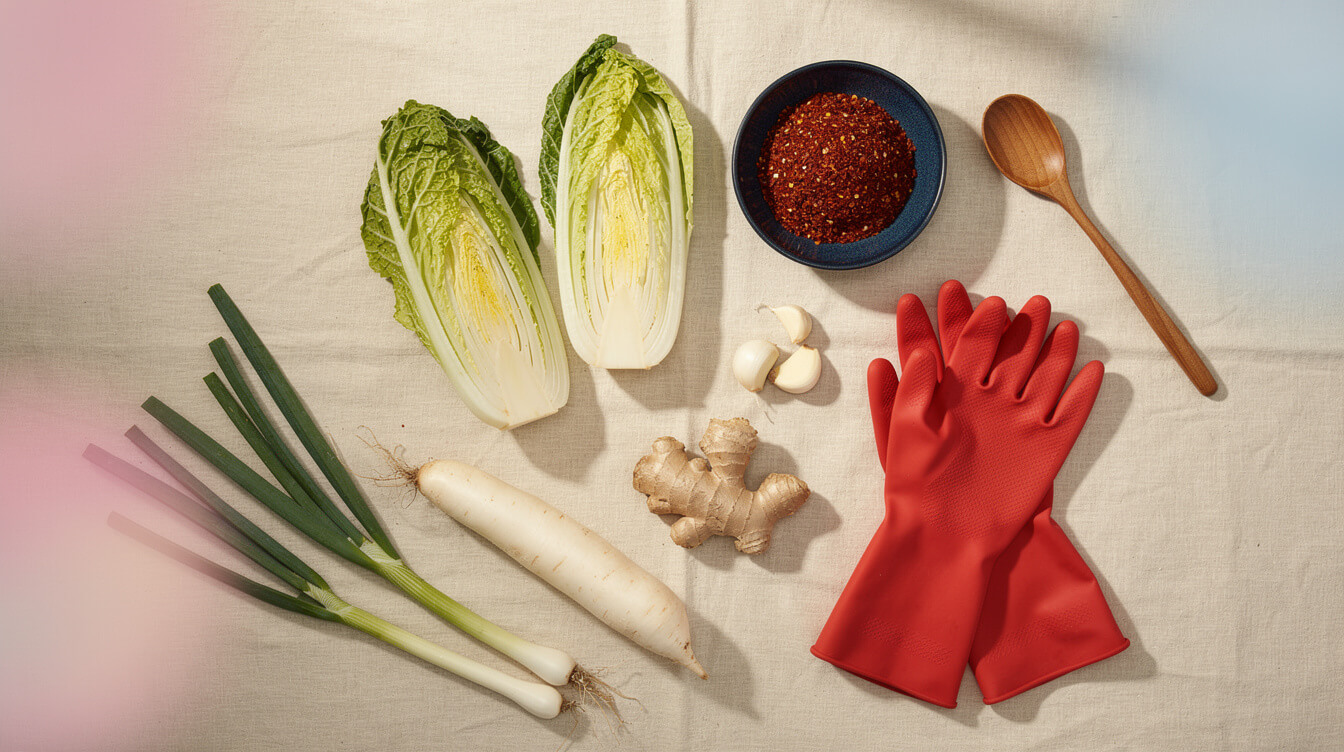
While the cabbage drains, someone makes the filling: 무 (mu, Korean radish) cut into thin strips, chili flakes, garlic, ginger, green onions, salted seafood or fish sauce, and whatever the family recipe adds. That seasoning mix has its own name, 김칫소 (gimchitso). A lot of people say 김칫속 (gimchitsok, “kimchi insides”), but the standard word is 김칫소. The 소 is the same word for “filling” you see in 만두소 (mandu-so, dumpling filling). Fun fact for your next family argument.
3. The assembly line
This is the part everybody remembers. People sit around a giant tub or a plastic sheet on the floor, pull on red rubber gloves (고무장갑, gomu janggap), and rub the filling between every single leaf of every half-head of cabbage. Then each piece gets folded up and packed tight into containers. Nobody is quiet. There is always one aunt checking everyone else’s technique.
4. The best lunch of the year
The day has its own menu. Someone boils a big piece of pork into 수육 (suyuk, boiled sliced pork), and you eat it wrapped in salted cabbage leaves with a spoonful of fresh filling. That’s basically 보쌈 (bossam), the wrap-it-up pork dish, made with the freshest ingredients you’ll get all year. Korea’s farm newspaper calls boiled pork the signature food of the day, and I have never met a Korean who disagrees.
The other treat is kimchi that’s barely kimchi yet. Fresh, unfermented, just-tossed cabbage is close to 겉절이 (geotjeori), a quick fresh kimchi. It’s crunchy, garlicky, and gone in minutes.
Fan mail
One email a week, written like a group chat
The Korean word everyone's using, the fandom ritual behind it, and the newest designs before they hit the shop. No spam. Unsubscribe anytime.
Kimjang words to know
Want to keep up with the conversation in the kitchen, or just understand your relatives’ texts? Here’s the vocabulary, with Hangul, Revised Romanization, and meaning.
- 김장 (gimjang): making winter kimchi in bulk, or the kimchi itself.
- 김장철 (gimjangcheol): kimjang season. 철 means “season”, as in “it’s that time of year”.
- 김장김치 (gimjang gimchi): kimjang kimchi, the winter batch.
- 배추 / 무 (baechu / mu): napa cabbage / Korean radish. The two stars.
- 고춧가루 (gochutgaru): chili flakes.
- 젓갈 (jeotgal): salted fermented seafood. Important if you have a shellfish allergy.
- 김칫소 (gimchitso): the seasoning filling rubbed between the leaves.
- 절임배추 (jeorim baechu): pre-salted cabbage, sold by the box.
- 고무장갑 (gomu janggap): rubber gloves. Red, always red.
- 수육 / 보쌈 (suyuk / bossam): boiled pork / pork wrapped with cabbage and kimchi.
- 겉절이 (geotjeori): fresh, quick kimchi eaten right away.
- 묵은지 (mugeunji): long-aged kimchi, deeply sour, great for stews. It became an official dictionary word only in 2015, after years of everyone using it anyway.
- 품앗이 (pumasi): trading labor. You help at my kimjang, I help at yours. More on this below.
- 김치냉장고 (gimchi naengjanggo): a kimchi refrigerator, the appliance that replaced burying jars in the yard.
Phrases you’ll actually hear
- 김장했어? (gimjang haesseo?): “Did you do kimjang yet?” Casual, for friends and siblings. To an elder: 김장하셨어요? (gimjang hasyeosseoyo?).
- 김장하러 가요. (gimjang hareo gayo): “I’m going to kimjang.” Perfect for explaining why you’re unavailable all weekend.
- 잘 먹겠습니다. (jal meokgetseumnida): “I’ll eat well”, what you say when someone hands you a container of their kimchi. Then say 감사합니다 (gamsahamnida, “thank you”) for good measure.
If the elders in your life are the ones running kimjang, our guide to Korean honorifics covers the polite endings, and the oppa, unnie, hyung, and noona explainer covers what to call everyone around the tub.
Sharing is the point of kimjang
The UNESCO listing isn’t just “making kimchi”. It’s “making and sharing kimchi”, and that’s deliberate. The kimchi was never meant to stay in one house.
The old system was 김장 품앗이 (gimjang pumasi). The National Institute of Korean History’s history portal describes neighbors going house to house through the season, helping with each family’s kimjang in turn and sharing the kimchi. Your neighbor’s whole household salted cabbage at your place on Saturday, and you showed up at theirs the next week. Every family’s recipe was a little different, so ideas and tricks traveled up and down the street with the kimchi. UNESCO points to exactly this exchange as how the skills get passed on and improved.
Charity kimjang and fan kimjang
The modern version is the charity kimjang. Every November, community centers, companies, religious groups, and volunteer organizations set up rows of tables in plazas and parking lots, and volunteers in aprons and red gloves season cabbage by the ton for low-income households and seniors who live alone. Seoul first held its own kimjang festival, 서울김장문화제 (Seoul Gimjang Munhwaje), in 2014, using Seoul Plaza to recreate the communal kimjang and share the results. If you’re in Seoul in November, the city’s official tourism site lists the current year’s dates.
And yes, fandom shows up here too. Korean fan clubs regularly turn up at charity kimjang events as a fan project, the same way fans organize birthday donations. A fan club donates in their artist’s name, and members put on aprons and season cabbage. One 2025 report described a single regional fan club sending 42 members to a charity kimjang day, alongside about 150 volunteers and social-welfare staff, that made kimchi for roughly 1,000 households. If you’ve ever wondered what fans mean when they talk about an idol’s “good influence”, this is a very literal version of it. (New to fan projects? Our bias explainer covers how fans celebrate the person they stan.)
Kimjang outside Korea: how diaspora families keep it
Growing up Korean abroad, kimjang looked different for us. Ours happened in a garage, with a folding table, two space heaters, and cabbage bought by the case from whichever grocery store had the best napa that week. My halmeoni ran it like a general. My job, at eight years old, was carrying containers and saying 잘 먹겠습니다 to anyone who handed me a slice of pork.
If you’re thinking about trying kimjang outside Korea, a few honest notes:
- Go small. A Korean family might do dozens of heads of cabbage. Two or three heads is a real kimjang for a first try, and it’ll fit in a regular fridge.
- Your fridge is your winter. The 4°C rule exists because Korean households used to ferment outdoors, in clay jars buried up to the neck so the kimchi wouldn’t freeze. You don’t need a cold snap. A fridge does the same job, which is why a diaspora batch can happen any weekend in late fall when the napa looks good.
- Ask for the family recipe now. UNESCO calls the recipe a family heritage, and it lives in someone’s hands, not on paper. Call the relative who makes the best kimchi. Ask how salty the brine is, how long the cabbage sits, and what goes into the filling. Write it down. A video is even better.
- Mind the seafood. Most recipes use salted shrimp, fish sauce, or both. If someone at your table has a shellfish allergy or doesn’t eat seafood, plan a separate batch without it and label the containers.
- Make it a party. The communal part is the point. Invite your friends, your Korean class, your concert group chat. Somebody boils the pork. Everybody goes home with a container.
For a lot of us in the diaspora, it’s also how love gets expressed without anyone saying it. A container of kimchi shows up at your apartment with no note. That’s the note. It’s the same energy as a parent texting 밥 먹었어? (bap meogeosseo?, “did you eat?”), which our guide to how Koreans really check in unpacks. And if the woman running your kimjang is a family friend rather than a relative, here’s what to call her, because it’s probably not ajumma.
Kimjang FAQ
Is kimjang a public holiday?
No. Kimjang isn’t on the official holiday calendar the way Seollal and Chuseok are. Families choose their own day, usually a weekend in the right temperature window. For Korea’s actual holidays, see our guide to saying happy new year in Korean, which covers Seollal.
When is kimjang in 2026?
There’s no single date. Using the normal dates above, the window runs from mid to late November in the colder inland north, around the end of November in Seoul, and into December and even January on the south coast. Private weather companies publish each year’s forecast in November.
Do Koreans still do kimjang?
Yes, though it has changed. Kimchi refrigerators mean nobody has to bury jars anymore. Plenty of people buy kimchi or pre-salted cabbage, and many younger adults simply receive a container from their parents. But family kimjang, charity kimjang, and school programs all keep it going, and that’s exactly why it was named national heritage.
What’s the difference between kimchi and kimjang?
Kimchi is the food. Kimjang is the seasonal event of making a big winter batch of it together, and also that batch itself.
How do I spell it: kimjang or gimjang?
Both are correct. Gimjang follows today’s official romanization. Kimjang is the older spelling that UNESCO uses. In Hangul, there’s only one: 김장.
Which kimchi gets made at kimjang?
Mostly whole napa cabbage kimchi, the classic red kind. Many families also make radish kimchi like 깍두기 (kkakdugi, cubed radish kimchi) or 동치미 (dongchimi, a cold radish water kimchi) on the same day, since the radish is at its best then too.

From the shop
Hwaiting Korean Tiger Cheering T-Shirt
Price range: $24.99 through $26.99
Shop this designFinal thoughts: the kimchi is the love letter
Kimjang looks like a cooking project, but it works more like a family reunion with a deadline. Everybody gets a job, everybody gets fed, and everybody leaves carrying something. The skills move between hands, not pages, and the kimchi moves from one fridge to the next until the whole street has some.
So if your group chat lights up with a mountain of cabbage this weekend, you’ll know what you’re looking at. Send a message to whoever’s wearing the red gloves. 김장 화이팅! (gimjang hwaiting, roughly “you’ve got this, kimjang crew”). Not sure what that last word means? Our hwaiting explainer has you covered. And if you’re in Seoul this season, pair a market full of cabbage with a slow day in Seongsu.
Before you log off
Get the next one in your inbox
We write about Korean phrases, fandom culture and concert life every day. The best of it lands in one short weekly email.