
Korean honorifics for fans: speech levels, -nim, -ssi, and what to say to your bias
Korean honorifics are the reason one Korean sentence can come in three outfits. “I’m going home” is 집에 갑니다 on a stage, 집에 가요 in an interview, and 집에 가 on a 2 a.m. live stream. Same meaning, three different levels of respect, and every Korean speaker picks one without thinking. If you’ve ever wondered why your bias sounds stiff at an award show and like your best friend on a live, this is why.
Grammar sites will hand you all seven speech levels, the archaic ones included, and a quiz. This guide is the fan version: the three levels you’ll actually hear, the little -시- that does most of the heavy lifting, the titles (-nim, -ssi, sunbae), and exactly what to write in a fan letter, say at a fansign, and type in a comment. There’s a mistakes list at the end, because we’ve all made them.
Korean honorifics, the short answer
Korean splits everyday speech into two big piles. 존댓말 (jondaenmal, “respectful speech”) is how you talk to people who are older than you, senior to you, or simply strangers. 반말 (banmal, “casual speech”) is how you talk to close friends, younger siblings, and anyone who has agreed to drop the formality with you. The name is honest: 반 (ban) is the character for “half,” so banmal is literally “half speech,” the version with the polite endings chopped off.
Korean honorifics show up in three places at once:
- The ending of the sentence, which shows respect to the person you’re talking to. That’s the speech level.
- The verb itself, which can lift up the person you’re talking about, using -시- or a special honorific verb.
- The words for people: titles like -님 and -씨, the humble 저 for “I,” and family words like 언니 and 형.
English does a little of this (“Mr. Kim,” “Would you mind…?”), but Korean builds it into nearly every sentence. The good news: once you can hear the endings, you can read a whole relationship from one line. A trainee speaking to a senior, a host speaking to a guest, two members bickering in banmal: the grammar tells you who’s who before the subtitles do.
One small pronunciation note, since you’ll see this word spelled two ways. 존댓말 is written with a ㅅ at the bottom of 댓, but it’s pronounced like “jon-daen-mal.” Revised Romanization follows the sound, so you’ll see jondaenmal, and also the letter-by-letter jondaetmal on fan sites. They’re the same word. You’ll also hear 높임말 (nopimmal, “raised speech”) used for honorific language.
The 3 speech levels you’ll hear in K-pop
Linguists count seven verb paradigms, or speech levels, in Korean. Three of them (hasoseo-che, hao-che, hage-che) now live mostly in historical dramas, religious language, some men’s speech, and regional dialects. If you’re watching K-pop content in 2026, you need three. Here’s “thank you” and “I’m going home” in each.
1. Formal polite: 하십시오체 (hasipsio-che)
Also called hapsyo-che. The endings are -ㅂ니다 / -습니다 for statements and -ㅂ니까 / -습니까 for questions.
- 감사합니다 (gamsahamnida): thank you.
- 집에 갑니다 (jibe gamnida): I’m going home.
This is the level of news anchors, military speech, customer announcements, and the stage. When a group lines up for an award acceptance or a formal debut greeting and says 감사합니다 and 사랑합니다 in unison, that’s hasipsio-che. It sounds crisp and public. In a one-on-one chat it can sound stiff, like answering a friend’s text in a press-release voice.
2. Casual polite: 해요체 (haeyo-che)
Take the casual form and add -요. That’s most of the rule.
- 고마워요 (gomawoyo) or 감사해요 (gamsahaeyo): thank you.
- 집에 가요 (jibe gayo): I’m going home.
Haeyo-che is the workhorse. It’s polite without being stiff, so it’s the safe default with strangers, shop staff, older people you know, and, yes, idols. Variety-show conversations and interviews mostly run on it. If you only learn one level, learn this one. You’ll never offend anyone with it.
3. Casual: 반말, the 해체 (hae-che)
Drop the -요.
- 고마워 (gomawo): thanks.
- 집에 가 (jibe ga): I’m going home.
This is banmal: close friends, younger siblings, the group chat. Members of the same group often talk to each other this way, especially once they’re past the trainee days. When an idol switches into banmal on a live stream, the room gets smaller. It sounds like they’re talking to a friend, which is exactly why fans love it.
There’s a fourth casual style worth recognizing: 해라체 (haera-che, the “plain” style), with endings like 간다 and 먹는다. You’ll mostly see it in writing (diaries, news headlines, book narration) and in quoted speech, so you’ll meet it in captions more often than in conversation.
The -시- that does the heavy lifting
Speech levels show respect to the listener. Korean has a second, separate move that shows respect to the subject of the sentence, the person doing the action. It’s a tiny syllable, -시- (-si-), slipped into the verb.
- 가다 (gada, to go) → 가세요 (gaseyo): “(you/they) go,” with respect.
- 읽다 (ikda, to read) → 읽으세요 (ilgeuseyo): “(you/they) read,” with respect.
- 오다 (oda, to come) → 오셨어요 (osyeosseoyo): “(you/they) came,” with respect.
That’s why 안녕히 가세요 (annyeonghi gaseyo) means “go in peace”: you’re honoring the person leaving. The -세요 you see on half of all polite Korean is -시- plus -어요, merged.
The special honorific verbs
A handful of everyday verbs swap out completely instead of just adding -시-. These are the ones you’ll hear constantly in family scenes, at the table, and in the polite morning greetings we covered in good morning in Hangul:
- 먹다 (meokda, to eat) → 드시다 (deusida). 맛있게 드세요 (masitge deuseyo): enjoy your meal.
- 있다 (itda, to be somewhere) → 계시다 (gyesida). 어머니 집에 계세요? (Is your mother at home?)
- 자다 (jada, to sleep) → 주무시다 (jumusida). 안녕히 주무세요 (annyeonghi jumuseyo): good night, to an elder.
- 말하다 (malhada, to speak) → 말씀하시다 (malsseumhasida).
Korean also has humble verbs that lower you in relation to the person you’re doing something for. 묻다 (to ask) becomes 여쭈다 (yeojjuda). 보다 (to see) becomes 뵈다 or 뵙다 (boeda, boepda), as in 처음 뵙겠습니다 (cheoeum boepgetseumnida), the formal “nice to meet you.” 주다 (to give) becomes 드리다 (deurida), as in 말씀드릴게요 (malsseumdeurilgeyo): “let me tell you.”
The golden rule: -시- and the honorific verbs go on other people, never on yourself. You don’t 주무시다. You just 자다, like everyone else.
This is also why English subtitles flatten so much. 엄마가 주무셔 and 엄마가 자 both come out as “Mom’s sleeping.” The respect is in the verb, and English has nowhere to put it.
Titles: -nim, -ssi, sunbae, and the family words

The third layer of Korean honorifics is what you call people. Using someone’s bare name is something you do with friends and people younger than you. Everyone else gets a title. Each of these deserves its own deep dive, and some will get one, so here’s the working version.
-님 (-nim): the respect suffix
님 is the all-purpose upgrade. Stick it on a job title and it becomes polite: 선생님 (seonsaengnim, teacher, and also a polite “sir/ma’am”), 사장님 (sajangnim, boss or shop owner), 작가님 (jakganim, writer or artist). Fans use 작가님 for fan artists and editors too, which is a lovely bit of respect for unpaid work.
님 also goes after a name or a username: ○○ 님. That’s how fans address each other in Korean fan spaces when they don’t know each other’s age. It’s polite, neutral, and age-proof. One spelling detail from the National Institute of Korean Language (국립국어원): after a person’s name or a nickname, 님 is written with a space (○○ 님). After a title, it attaches directly (선생님). The Institute also notes that “가수 ○○ 님” (singer + name + 님) reads more naturally than tacking 님 onto the job word after the name.
-씨 (-ssi): polite, but not for your seniors
씨 looks like the Korean “Mr./Ms.,” but it doesn’t work the same way. The Standard Korean Language Dictionary defines it as a way to address an adult respectfully by their name, then adds the catch: outside formal or official settings, it’s hard to use for someone above you. It’s mostly used for peers and people junior to you. Coworkers at the same level, a stranger your age, a younger colleague: 씨. Your teacher, your boss, your friend’s mom: not 씨.
Two more rules. Like 님 after a name, 씨 gets a space (○○ 씨). And you never put 씨 on your own name. More on that in the mistakes section. We’ll give 씨 its own full post, because the “is it rude?” question has more layers than one section can hold.
선배 (seonbae): the person who came before
선배 (seonbae) comes from the Sino-Korean 先輩, “one who went ahead”: a senior in a school, a company, or any organization. The person who came after you is your 후배 (hubae). In the music industry, debut order works a lot like class year, which is why you’ll hear idols greet artists who debuted earlier as 선배님 (seonbaenim), even when the age gap is small. Sunbae culture is a whole topic (who bows first, who pays for dinner), so it’s getting a post of its own.
The family words
오빠, 언니, 형, and 누나 are titles, too. They turn a slightly older person into a kind of chosen sibling. They’re warm, they depend on your gender and theirs, and they come with their own rules about when they’re sweet and when they’re too much. We broke them down in our guide to oppa meaning in Korean. For strangers on the street, the set of 아저씨, 아줌마, and their politer alternatives is in ajumma meaning.
Fan mail
One email a week, written like a group chat
The Korean word everyone's using, the fandom ritual behind it, and the newest designs before they hit the shop. No spam. Unsubscribe anytime.
How fans talk to idols with Korean honorifics
Here’s the practical part. An idol is usually a stranger to you, often older, and always someone you want to be kind to. So the default is simple: 해요체, with -시- on their actions, and 저 for yourself. You can’t go wrong with it. Below are copy-ready lines for the three places fans actually use Korean.
In a fan letter
Letters can sit a notch more formal than speech, and that’s charming, not stiff. A simple template, with ○○ standing in for your bias’s name:
- ○○ 님께 (○○ nimkke): To ○○. 께 is the honorific “to.”
- 안녕하세요. 저는 미국에 사는 팬이에요. (Hello. I’m a fan who lives in the US.)
- 항상 좋은 음악 들려주셔서 감사해요. (Thank you for always letting us hear good music.) Note the -시- in 들려주셔서: you’re honoring their action.
- 무대를 보면서 힘을 많이 얻어요. (I get so much strength from watching your stages.)
- 건강 잘 챙기세요. (Please take good care of your health.)
- 늘 응원할게요. (I’ll always cheer you on.)
- ○○ 드림 (○○ deurim): From ○○. 드림 is the humble “given by,” from 드리다.
If you’re writing a birthday letter, our happy birthday in Hangul guide has the greetings and card layout. And if you add 화이팅 at the end, nobody will mind.
At a fansign or video call
You have seconds, so keep it short and in haeyo-che:
- 안녕하세요, 미국에서 왔어요. (Hi, I came from the US.)
- 만나서 정말 반가워요. (I’m so happy to meet you.)
- 오늘 무대 너무 좋았어요. (Today’s stage was so good.)
- 제 이름 이렇게 써 주실 수 있어요? (Could you write my name like this?) Point at your sticky note.
Notice 제 (je), the humble “my,” instead of 내 (nae). And notice 써 주실 수 있어요: -시- again, on the idol’s action, never on yours.
In comments
Comments are where the rules loosen. You’ll see plenty of Korean fans comment in banmal, especially with 오빠 or 언니 in front, and it reads as affectionate, the way a younger sibling talks. That intimacy is part of fan culture. But haeyo-che is never wrong, and if you’re not a native speaker, it keeps your Korean sounding warm instead of accidentally rude:
- 오늘도 최고였어요. (You were the best today too.)
- 푹 쉬세요. (Get some good rest.) That’s -시- on 쉬다, to rest.
- 생일 축하해요. (Happy birthday.)
One more fandom note: when you talk to other fans online and don’t know their age, use their handle with 님 and stay in haeyo-che. In Korean fan spaces, banmal to a stranger reads as rude even when you meant it as friendly.
When it’s OK to drop to banmal (말을 놓다)
Switching from 존댓말 to 반말 is a real moment in a Korean relationship, and it has its own phrase: 말을 놓다 (mareul nota), literally “to put down the speech.” In conversation the particle usually drops: 말 놓다.
The usual script goes like this. Usually it’s the older or more senior person who offers first:
- 말 놓으세요. (mal noeuseyo): Please speak casually to me.
- 말 편하게 하세요. (mal pyeonhage haseyo): Talk comfortably. Same meaning, softer.
The younger person can ask, too, but it’s a question, not an announcement:
- 말 놔도 돼요? (mal nwado dwaeyo?): Is it OK if I speak casually? (놔 is the contracted 놓아.)
Age matters here, which is why Koreans meeting as adults often ask each other’s birth year early on. It isn’t nosiness. It sets the grammar. Our guide to the maknae meaning covers how age order works and the 2023 change to how Korea officially counts age.
A few ground rules for fans:
- Friends your own age: banmal is normal once you’ve agreed to it. Ask, or wait to be asked.
- Older mutuals: stay in haeyo-che until they offer. If they call you by name and you call them 언니 or 형, you’re probably there.
- Idols: when an idol talks to fans in banmal on a live, that’s their warmth, not an invitation to do it in a letter. In writing, haeyo-che is the respectful default.
- Family: many Korean kids speak banmal to their parents, and many speak polite Korean to grandparents. Every family is different. Follow the house rules.
Common mistakes with Korean honorifics
Every learner makes these. Most native speakers will smile and understand you anyway, but fixing them makes your Korean sound like it came from a person, not an app.
1. Putting -시- on yourself
제가 하실게요 sounds like you’re honoring yourself. It’s just 제가 할게요 (I’ll do it). The same slip happens in Korea’s service industry, where you’ll sometimes hear 커피 나오셨습니다, which politely honors the coffee. Koreans joke about it. The coffee does not need -시-.
2. Putting 씨 on your own name
Introduce yourself as 저는 서하나예요 (I’m Seo Hana), never 저는 서하나 씨예요. Titles go on other people.
3. Using 당신 for “you”
Dictionaries list 당신 (dangsin) as “you,” and textbooks used to teach it that way. In real conversation, it’s mostly heard between married couples, in song lyrics, and in arguments, which is not the tone you want in a fan letter. Koreans usually skip “you” entirely or use the person’s name or title. We dug into this in how are you in Hangul.
4. Mixing 나 with -요
나 (na) and 내 (nae) are the casual “I” and “my.” In polite speech they become 저 (jeo) and 제 (je). 나는 팬이에요 isn’t wrong grammatically, but it mixes two levels. 저는 팬이에요 matches. Same for “we”: the humble form is 저희 (jeohui).
5. Going full formal in a friendly chat
Sending a Korean friend your age 감사합니다, 알겠습니다, and 좋습니다 every time can feel cold, like you’re keeping them at arm’s length. Haeyo-che is the friendly middle.
6. Using a title where a name would do (or the reverse)
Calling an older coworker by their bare name is a big one. So is calling your close friend 씨 after you’ve agreed to banmal. It sounds like you’re mad at them.
Korean honorifics: quick FAQ
What are Korean honorifics called in Korean?
The polite speech is 존댓말 (jondaenmal) or 높임말 (nopimmal). Casual speech is 반말 (banmal). The honorific grammar system as a whole is often called 높임법 (nopimbeop).
How many speech levels does Korean have?
Seven are traditionally counted, but three cover modern K-pop and daily life: formal polite (하십시오체), casual polite (해요체), and casual (반말). The rest are mostly heard in historical dramas, religious language, or regional speech.
Is it rude to use banmal with an idol?
In a comment, plenty of Korean fans do, and it reads as affectionate. In a letter or face to face at a fansign, haeyo-che is the respectful choice, especially if the idol is older than you. If you’re unsure, go polite. Nobody has ever been offended by 해요체.
Is oppa an honorific?
It’s a title, and it often comes with banmal, because it signals closeness. So “oppa” plus haeyo-che is common and sweet, and “oppa” plus formal 하십시오체 sounds a bit like a joke. The full story is in our oppa guide.
Do I use honorifics in a text?
Yes, the same rules apply. Texting doesn’t reset the relationship.
What’s the safest level for a beginner?
해요체 with 저 for “I.” It works with strangers, shop staff, older fans, and idols. Add -시- when you talk about what someone else is doing, and you’re already more polite than most learners.
From the shop
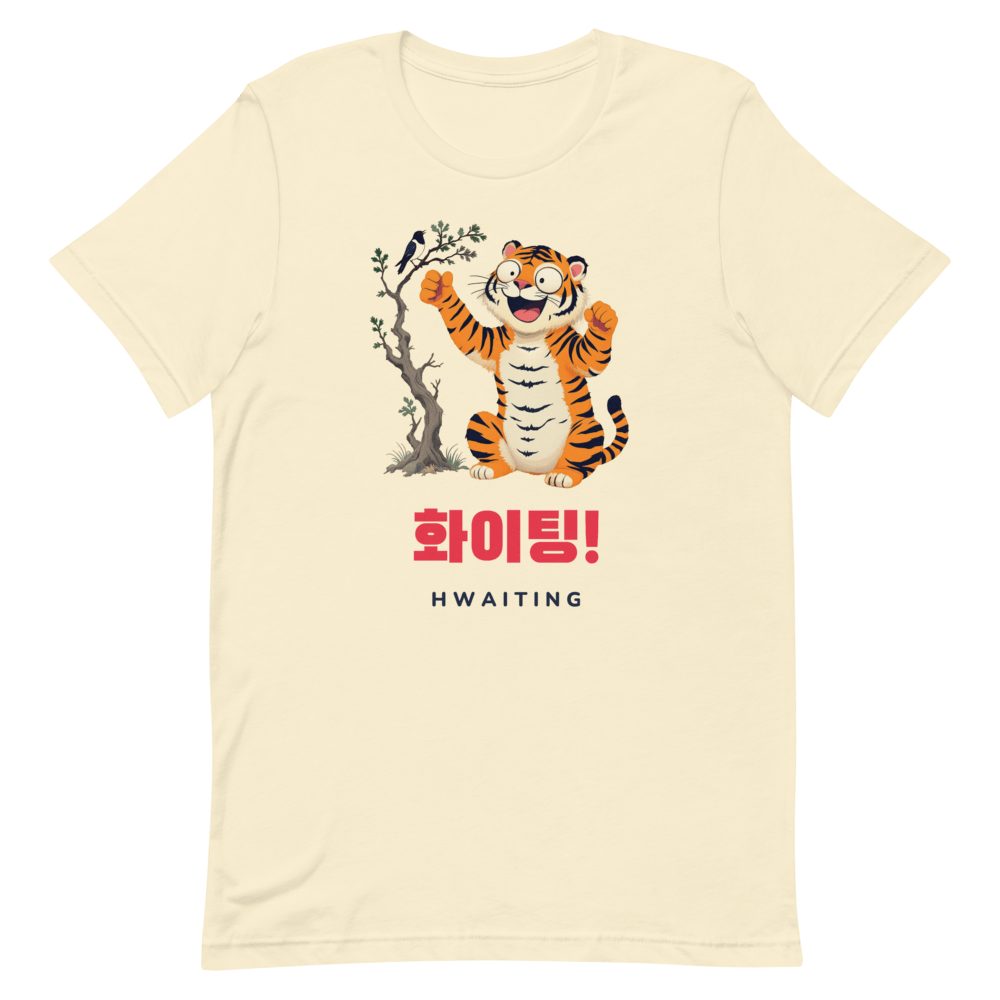
Hwaiting Korean Tiger Cheering T-Shirt
Price range: $24.99 through $26.99
Shop this designFinal thoughts: respect is a language skill
Korean honorifics look like a wall of endings at first. Then one day you notice the switch: a host goes from 하십시오체 to haeyo-che when the cameras relax, two members drop into banmal mid-sentence, two new friends finally agree to 말 놓다. The grammar was telling a story the whole time.
You don’t need all seven levels. Learn 해요체, put -시- on other people and never on yourself, use 저 and 제 for you, and save banmal for the people who’ve invited you there. That’s enough to write a fan letter that sounds like a person wrote it, which is the whole point. If you want to see how this plays out across the year, our happy new year in Korean guide walks through the formal, polite, and casual versions of the biggest greeting of the year. 화이팅!
Before you log off
Get the next one in your inbox
We write about Korean phrases, fandom culture and concert life every day. The best of it lands in one short weekly email.