

Cute in Hangul: 귀여워 and every way fans say it
If you have ever watched a live stream with the comments scrolling, you have seen the word fly past a hundred times: 귀여워. The word for cute in Hangul is 귀여워 (gwiyeowo), the casual form of the adjective 귀엽다 (gwiyeopda, “to be cute”). Fans type it, shout it at fansigns, and write it on slogans. Then they go looking for it in English and find three different spellings: kiyowo, kiyo, kyeopta. So which one is right? All of them come from the same word, and by the end of this post you’ll know how to read it, write it, spell it, and turn it all the way up.
We’ll go block by block through the Hangul, solve the spelling mystery, sort out cute from pretty, handsome, and cool, and settle the question every fan with an older bias eventually asks: can you call someone older cute?
Cute in Hangul: 귀여워 (gwiyeowo), the short answer

Here is the whole word family on one screen:
- 귀엽다 (gwiyeopda): the dictionary form, “to be cute”. You’ll also hear it out loud as a little exclamation, half to yourself, when a puppy trots past.
- 귀여워 (gwiyeowo): casual, “cute” or “you’re cute”. This is the one in every comment section.
- 귀여워요 (gwiyeowoyo): polite. Safe with almost anyone.
- 귀엽습니다 (gwiyeopseumnida): formal. Announcers, speeches, very careful letters.
- 귀여운 (gwiyeoun): “cute” in front of a noun, as in 귀여운 강아지 (gwiyeoun gangaji, a cute puppy).
One thing English speakers trip over: Korean adjectives behave like verbs. 귀엽다 doesn’t mean “cute” the way the English word sits quietly in front of a noun. It means “to be cute”, and it conjugates. So 귀여워 on its own is already a full sentence. “It’s cute.” “You’re cute.” “He’s cute.” “This photocard is cute.” Korean drops the subject when context makes it obvious, and in a comment under a fancam, the context is always obvious.
Cute is not a small word in Korean. It is the word behind 애교 (aegyo), acting cute on purpose, which we covered in what is aegyo, and it is the reason 귀요미 (gwiyomi, “cutie”) became a whole meme. Here we stay with the plain word itself, because you will use it more often than any of its spin-offs.
Reading 귀엽다 block by block
Hangul is built in syllable blocks, and each block stacks a consonant, a vowel, and sometimes a final consonant. 귀엽다 has three blocks:
- 귀 (gwi): ㄱ (g/k) + ㅟ (wi). ㅟ is itself two vowels stuck together, ㅜ (u) and ㅣ (i), which glide into “wi”.
- 엽 (yeop): ㅇ (silent at the start of a block) + ㅕ (yeo) + ㅂ (p, as a final consonant).
- 다 (da): ㄷ (d) + ㅏ (a). Every Korean dictionary form ends in 다, so this block is grammar, not meaning.
Said aloud, the ㄷ after a final ㅂ hardens, so 귀엽다 sounds like [귀엽따], roughly “gwee-yup-ttah”.
Why 귀엽다 turns into 귀여워
Here is where the ㅂ goes missing. 귀엽다 is what Korean grammar calls a ㅂ-irregular adjective. When you add an ending that starts with a vowel, the final ㅂ turns into 우 (u), and 우 plus the ending 어 (eo) fuses into 워 (wo). So:
귀엽 + 어 → 귀여우 + 어 → 귀여워
That’s why the casual form has a 워 block the dictionary form doesn’t. Once you see the pattern, you’ll spot it everywhere, because some of the most-used words in Korean follow it:
- 덥다 (deopda, to be hot) → 더워 (deowo)
- 춥다 (chupda, to be cold) → 추워 (chuwo)
- 맵다 (maepda, to be spicy) → 매워 (maewo)
Which means that the vocabulary for queueing outside a winter concert (추워), eating tteokbokki after it (매워), and watching the encore stage on your phone on the train home (귀여워) all runs on the same rule. Korean is efficient like that.
A fun etymology note, flagged as a “likely” by the dictionaries rather than a sure thing: Wiktionary traces 귀엽다 back to an old verb 괴- (goe-), “to love”. If that holds, calling something cute in Korean was once very close to saying you love it, which every fan who has typed 귀여워 at 2 a.m. already knew. For the word that took the “love” job directly, see what saranghae means.
Kiyowo, kiyo, and kyeopta: the fan spellings explained
Search “what does kiyowo mean” and you’ll find thousands of fans asking the same thing, because the official romanization and the way fans write it look nothing alike. Here’s what is going on.
Gwiyeowo is the Revised Romanization, South Korea’s official system, the one on road signs and in most textbooks. It writes ㄱ at the start of a word as “g”.
Kiyowo is how the word sounds to many English-speaking ears, spelled the way they hear it. Two things push it there:
- The ㄱ. Korean ㄱ at the start of a word is unvoiced and not puffed with air the way English “k” is. It falls between English “g” and “k”, and plenty of listeners hear a k. The older McCune-Reischauer romanization agrees with them: it writes the dictionary form as kwiyŏpta.
- The ㅟ. In quick speech, the “wi” glide often collapses. Wiktionary lists two standard Seoul pronunciations for 귀엽다, one with a clear “gwi” glide and one with a single rounded vowel closer to the “ü” in German. That rounded vowel, followed by 여, lands on English ears as “kee-yo” or “kyo”.
Kiyo is a fandom clipping of kiyowo. You’ll see it in English-language comments and captions. Treat kiyo as fan English rather than a Korean word.
Kyeopta is the same squeeze applied to the dictionary form 귀엽다: “gwi-yeop-da” compressed into two syllables, with the hardened ㄷ written as “t”. It has been in fan vocabulary for years. The Jakarta Post listed it in a 2017 piece on Korean words in K-pop fan language, glossed as “that’s cute” and noted as originally pronounced gwiyeopda.
So which should you write? In Hangul, there’s only one answer: 귀여워. In English, use gwiyeowo if you’re learning or writing something you want to look up later, and use kiyowo if you’re in a fan space where everyone already reads it that way. Nobody in the replies will correct you, and if they do, now you can explain why both exist.
Polite, formal, and casual: every form of cute in Hangul
Korean changes the ending of a word depending on who you’re talking to. With cute, you need four forms for nearly every real situation.
Casual: 귀여워 (gwiyeowo)
For friends your age, younger siblings, your group chat, pets, babies, and yourself. It’s also the default in fan comments, because fan comments aren’t really addressed to anyone. 귀여워 under a photo is a reaction, not a conversation.
Polite: 귀여워요 (gwiyeowoyo)
Add 요 and you can say it to a stranger, a shop owner, a coworker, or the person next to you in the merch line whose bag charm you love. If you’re unsure, use 요. It never hurts.
Honorific: 귀여우세요 (gwiyeouseyo)
This adds the honorific marker 시, which lifts the person you’re describing rather than just being polite to them. “You’re cute” said with respect. It’s the safe choice for someone older you’re close to, and it matters for the last big question in this post.
Formal: 귀엽습니다 (gwiyeopseumnida)
The broadcast form. You won’t need it in conversation, but you’ll hear it from MCs and in formal speech.
Past tense and reactions
- 귀여웠어 (gwiyeowosseo): “it was cute”, as in last night’s live.
- 귀여웠어요 (gwiyeowosseoyo): the polite version.
- 귀엽네 (gwiyeomne): “oh, that’s cute”, with the gentle surprise of the ending 네. Notice the ㅂ turns into an m sound before ㄴ, which is why it’s romanized with an m.
Cute + noun: 귀여운
To put cute in front of something, use 귀여운 (gwiyeoun):
- 귀여운 강아지 (gwiyeoun gangaji): a cute puppy
- 귀여운 고양이 (gwiyeoun goyangi): a cute cat
- 귀여운 아기 (gwiyeoun agi): a cute baby
The noun form, cuteness itself, is 귀여움 (gwiyeoum), which is also the root that 귀요미 grew out of.
Fan mail
One email a week, written like a group chat
The Korean word everyone's using, the fandom ritual behind it, and the newest designs before they hit the shop. No spam. Unsubscribe anytime.
Cute vs pretty vs handsome vs cool
English uses “cute” for a lot of jobs, including “hot, but I’m being casual about it”. Korean splits that work across four words, and fans use all four in the same comment section, sometimes in the same sentence.
귀엽다 (gwiyeopda): cute
Small, soft, endearing, or funny in a lovable way. A sleepy puppy. A mispronounced English word in a live. A member wearing a hoodie two sizes too big. Cute is about how something makes you feel protective and happy, not about whether it’s good-looking. You can call anyone cute, at any age.
예쁘다 (yeppeuda): pretty
예뻐 (yeppeo), 예뻐요 (yeppeoyo). Pretty, lovely, beautiful. Used for people (most often women and children), but also for anything visually nice: a dress, a view, handwriting, a sunset over the Han River. Wiktionary also lists “adorable” and “nice, good” among its meanings, so parents say 예뻐 to a kid who did something kind. You’ll also see 이쁘다 (ippeuda), a common colloquial spelling.
잘생겼다 (jalsaenggyeotda): handsome
This one has a grammar surprise. It comes from 잘 (jal, well) + 생기다 (saenggida, to appear or come about), and it’s almost always used in past tense: 잘생겼어 (jalsaenggyeosseo), 잘생겼어요 (jalsaenggyeosseoyo). Literally, “came out well”. So when you call someone handsome in Korean, you’re grammatically saying their face turned out right. In front of a noun it becomes 잘생긴 (jalsaenggin): 잘생긴 사람, a good-looking person. It’s mostly said about men, though it isn’t restricted to them.
멋있다 (meositda): cool
멋있어 (meosisseo), 멋있어요 (meosisseoyo). Cool, stylish, impressive, wonderful. This is the stage word: the powerful choreography, the vocal run, the moment a member gives a thoughtful answer in an interview. It describes presence and style more than looks, and you can say it about anyone. 멋지다 (meotjida) is a close cousin with the same feel.
How fans use all four
The fun is in the switch. Fans love the moment a performer is 멋있어 on stage and 귀여워 the second the music stops. That contrast is half of what fans mean by “gap”, and it’s a big part of how people pick a bias (and why the bias and bias wrecker struggle is real). A typical reaction might read 무대에서는 멋있는데 너무 귀여워: “So cool on stage, but so cute.”
Turning it up: 너무, 진짜, and 귀여워 죽겠어
Nobody types just 귀여워 when the cuteness is serious. Here’s how to scale it.
너무 귀여워 (neomu gwiyeowo): so cute
너무 (neomu) means “too” or “so”, and it’s the most common intensifier in fan Korean. It also has a backstory. For years, Korea’s standard dictionary defined 너무 as “excessively”, which made phrases like 너무 예쁘다 (“too pretty”) technically wrong, and copy editors corrected them. On June 15, 2015, the National Institute of Korean Language revised the definition so that 너무 could describe positive things too. Its Q&A page now says plainly that 너무 works in positive and negative contexts alike. So the whole internet typing 너무 귀여워 is officially fine.
진짜 귀여워 (jinjja gwiyeowo): really cute
진짜 (jinjja) means “real” or “really”. It’s a little more emphatic, a little more “I’m not exaggerating”. 정말 (jeongmal) means the same and sounds a touch more polite: 정말 귀여워요. Stack them and you get 진짜 너무 귀여워, which is exactly what it sounds like.
귀여워 죽겠어 (gwiyeowo jukgesseo): so cute I could die
The pattern “adjective + 죽겠어” (jukgesseo, roughly “I’m going to die”) is the Korean version of “I’m dying” or “I can’t”. People use it for anything extreme: 더워 죽겠어 (it’s so hot I’m dying), 배고파 죽겠어 (I’m starving). With cute, it’s pure affection: 귀여워 죽겠어 is what you say about a puppy, a nephew, or a bias who just tripped over their own shoelace and laughed about it. It’s casual and dramatic, so keep it for friends and comment sections, not for your teacher.
If you like how these react-words work, daebak is the same kind of word for “amazing”, and you’ll often see the two side by side.
Typing it fast: ㄱㅇㅇ, 700, and 커엽다
Korean online writing is fast and playful, and 귀여워 has picked up a few shortcuts. You’ll see these in Korean comments and fan posts, so it helps to recognize them.
ㄱㅇㅇ
Korean texters often type just the first consonant of each syllable. 귀여워 starts with ㄱ, ㅇ, ㅇ, so ㄱㅇㅇ means “cute”. It’s the same habit that turns laughter into ㅋㅋㅋ. You’ll often see ㄱㅇㅇ followed by a heart.
700
Look at ㄱㅇㅇ again. Squint. It looks like the number 700. The JoongAng Ilbo’s slang column explained 700 as exactly that: the initials of 귀여워, written as the number they resemble. If you see 700 under a picture of a kitten, nobody is quoting a price.
커엽다
Swap the 귀 for a 커 and you get 커엽다 (keoyeopda), or 커여워 in the casual form. This comes from 야민정음 (yaminjeongeum), a Korean internet game of replacing letters with others that look similar. According to Korean Wikipedia, it grew up on a domestic baseball board on the DCInside forum, and the name is a pun on 훈민정음 (Hunminjeongeum), the 15th-century document that introduced Hangul. Put 귀 and 커 side by side and you’ll see the joke: the shapes are nearly mirror images. Wiktionary lists 커엽다 as a term derived from 귀엽다.
Use these in fan spaces with friends. Don’t put them in a letter to a host family or an essay for your Korean class. If you want a clean, handwritten version for a slogan or a fan letter, 귀여워 in full is always right.
Can you call someone older cute?
Yes, but how you say it matters.
In Korean, 귀엽다 isn’t only for babies and puppies. People say it about adults all the time, including people older than them: a dad who is proud of his new phone, a grandmother doing a dance at a family party, an older coworker who gets flustered by a compliment. Fans say it about idols who are older than they are every single day. What changes is the form and the setting (the whole age-and-title system is in our guide to oppa and the other Korean honorifics).
- Talking about them, not to them. 귀여워 in a comment or to a friend is fine. You’re reacting, not addressing anyone.
- Talking to someone older you’re close with. Use the honorific: 귀여우세요 (gwiyeouseyo). It reads as warm and respectful, especially about something they did rather than how they look.
- Talking to a boss, teacher, or someone you just met. Here’s where it can go wrong. Calling a senior person cute to their face can sound like you’re talking down to them, even with polite endings. With a teacher or a senior at work, a compliment like 멋있으세요 (meosisseuseyo, “you’re impressive”) usually lands better.
The same logic explains why the youngest in a group is so often cast as “the cute one” (more on that in maknae meaning), and why fans love it when an older member is the cute one instead. Cute flowing down the age ladder is expected. Cute flowing up it is a surprise, and surprises are adorable.
One more etiquette note. Cute is wholesome. Keep it that way, especially about idols. 귀여워 is a compliment about charm and joy, not a hint at anything else.
Cute in Hangul: quick FAQ
How do you write cute in Hangul?
귀여워 (gwiyeowo) for casual speech, 귀여워요 (gwiyeowoyo) to be polite. The dictionary form is 귀엽다 (gwiyeopda).
What does kiyowo mean?
It’s a fan spelling of 귀여워, “cute”. The official romanization is gwiyeowo. Kiyo is a shorter fan version of the same word.
What is kyeopta?
A fan spelling of 귀엽다, the dictionary form of “to be cute”, squeezed into two syllables the way it can sound in fast speech.
How do you say “you’re so cute” in Korean?
너무 귀여워 (neomu gwiyeowo) to a friend, 너무 귀여워요 (neomu gwiyeowoyo) politely. Korean usually drops the “you”, so you don’t need to add it. Avoid using 당신 for “you”, which can sound cold or odd to someone you aren’t married to (we explain why in how are you in Hangul).
What does ㄱㅇㅇ mean?
The first consonants of 귀여워. It means “cute”. 700 means the same thing, because ㄱㅇㅇ looks like 700.
Is cute the same as aegyo?
No. 귀엽다 describes something as cute. 애교 (aegyo) is acting cute on purpose: the voice, the pout, the finger heart at the camera. Aegyo is usually trying to get a 귀여워 out of you.
Can boys be called cute in Korean?
Absolutely. 귀엽다 works for anyone. If you mean “good-looking” rather than “endearing”, use 잘생겼다 (jalsaenggyeotda).
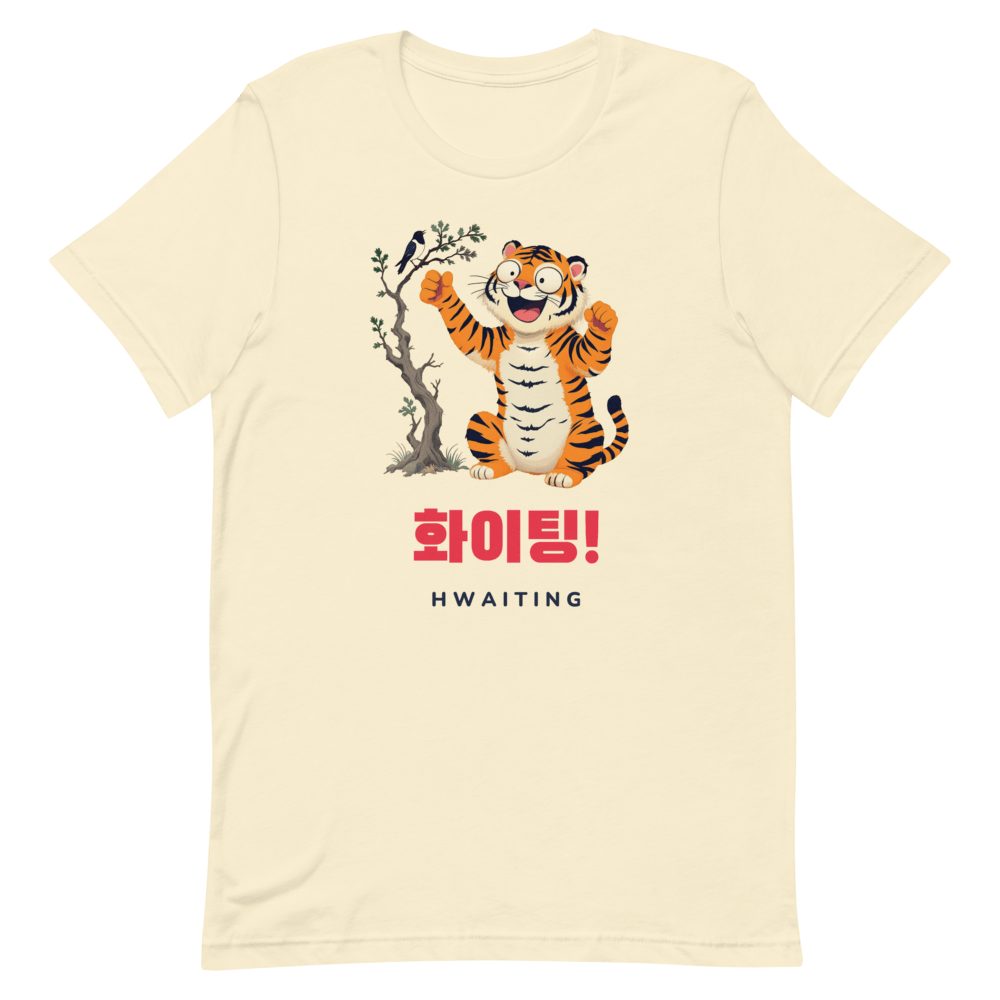
From the shop
Hwaiting Korean Tiger Cheering T-Shirt
Price range: $24.99 through $26.99
Shop this designFinal thoughts: say it like you mean it
Cute in Hangul is one word, 귀여워, with a lot of personality: a ㅂ that disappears, a ㄱ that sounds like k to half the world, a polite 요 for strangers, a 너무 that was officially fixed in 2015, and a 죽겠어 for when one word is not enough. You can spell it gwiyeowo, kiyowo, or ㄱㅇㅇ, and every fan in the comments will know what you mean.
Next time something makes your heart do that little squeeze, a sleepy puppy, a fumbled ending pose, a friend’s handwritten fan letter, skip the English. Type 귀여워. Then, if it really got you, add 진짜 너무 in front and 죽겠어 at the end.
Before you log off
Get the next one in your inbox
We write about Korean phrases, fandom culture and concert life every day. The best of it lands in one short weekly email.