Korean finger heart: how to make it, what it means, and where fans use it
You’ve seen it a thousand times. An idol leans toward the camera at the end of a stage, crosses a thumb over an index finger, and there it is: a tiny heart, about the size of a fingernail. That’s the Korean finger heart, and it might be the most-used piece of body language in the whole fandom. It shows up in the encore, at the fansign table, on photocards, in selcas, and in every group chat as 🫰.
It looks simple. Then you try it in your phone’s front camera and it comes out looking like an “OK” sign, or like you’re asking someone to pay you back. This guide fixes that. We’ll cover what the Korean finger heart means, how to make it properly, where it came from (honestly), the whole family of heart gestures, the emoji, and where fans actually use it.
What the Korean finger heart means
In Korean, the gesture is usually called 손가락 하트 (songarak hateu, “finger heart”). 손가락 means finger and 하트 is the English word “heart” borrowed straight into Korean. You’ll also hear the shorter 손하트 (sonhateu, “hand heart”), from 손 (son, “hand”) plus 하트. In casual speech, 손하트 can mean the finger heart or the two-hand version, and context tells you which one.
Pronunciation tip: 손가락 is written with a plain ㄱ, but it’s pronounced with a tensed sound, closer to “son-kka-rak”. The tense sound comes from an old possessive particle between 손 and 가락 that dropped out of the spelling but stayed in the pronunciation. Revised Romanization doesn’t show that tensing, which is why you see it spelled songarak.
So what does it mean? The same thing a heart means anywhere: love, thanks, “you’re the best”, “I see you”. The Korean finger heart just says it smaller and faster. It’s the visual version of 사랑해 (saranghae, “I love you”), which is why it travels with that word everywhere. (Our saranghae guide covers the words. This post covers the hands.)
The tone is warm and light rather than romantic. You can send a finger heart to your bias, your best friend, your mom, a stranger who held the door, or a whole stadium. Nobody reads it as a love confession. It’s closer to a wink than a proposal.
Why it’s so popular
Three reasons, from someone who has made roughly ten thousand of them:
- It takes one hand. Your other hand is holding a lightstick, a phone, a bubble tea, or a photocard binder.
- It’s quick. It takes half a second, so it fits into the last beat of a song, the end of a selca, or the moment an idol looks your way.
- It’s small and a little shy. A big arm heart is a statement. A finger heart is a wink. That’s exactly why it feels personal.
How to make a Korean finger heart, step by step
Here’s the method. Do it along with the text, ideally with your front camera open.
- Make a loose fist. Curl your middle, ring, and little fingers into your palm. They stay tucked away for the whole gesture.
- Bend your index finger slightly. Don’t curl it all the way. It should arch a little, like you’re about to tap a screen.
- Bring your thumb across the index finger. Lay the pad of your thumb over the side of your index finger, near the tip, so the two cross. This is the same position your fingers are in just before you snap.
- Find the heart. Where the thumb tip and index fingertip cross, the two fingertips make the two rounded tops of a heart, and the point where they meet makes the bottom. Slide your thumb up or down a few millimeters until the shape clicks.
- Angle it toward the viewer. Tilt your wrist until the heart reads clearly from the front. Check it in your camera. If you can’t see a heart, nobody else can either.
In Korean, your thumb is 엄지손가락 (eomjisongarak, often just 엄지, eomji) and your index finger is 집게손가락 (jipgesongarak). Not essential for making a heart, but now you can follow a Korean tutorial video without pausing.
The 3 most common mistakes
1. Making a circle instead of a cross. If your thumb and index fingertips touch tip-to-tip in a ring, you’ve made an “OK” sign. The finger heart needs the fingers to overlap, not meet. Cross them.
2. Keeping the index finger flat. A straight index finger plus a thumb on top looks like a pinch, or like you’re measuring something tiny. Bend the index finger so the tip curves. The curve is what gives the heart its round top.
3. Hiding it. A finger heart at chest height in a crowd of thousands is invisible. At a concert, raise it up toward the stage, ideally in the light. In photos, bring it up near your face, where the camera is already focused.
Bonus tip: if your hands are small, or you’re wearing gloves at an outdoor show in winter, exaggerate the bend in the index finger. A bigger arch gives you a bigger heart.
Where the finger heart came from
Here’s the honest version: nobody can say for sure who did it first. The finger heart spread through Korean entertainment in the 2010s, and Emojipedia’s description of the 🫰 emoji says exactly that: the gesture was popularized in the 2010s by South Korean celebrities, including actors, K-pop stars, and comedians. Different celebrities have been credited with it over the years, and at least one has playfully claimed it on a variety show. Even Wikipedia’s article on the gesture flags parts of its origin story as needing better sources. So we won’t crown anyone. Fans know the debate, and it’s more fun as a debate anyway.
What we can say is how it looked along the way. Korean entertainment news photos in the early and mid-2010s sometimes captioned the pose 소심한 브이 (sosimhan beui), “the timid V”. 소심하다 (sosimhada) means to be timid or faint-hearted, and 브이 is the letter V. The joke is that it looks like a peace sign that lost its nerve: the two fingers come together instead of spreading out.
That nickname makes sense once you know the backstory. For decades, the V sign was the default photo pose across East Asia. One popular theory traces its spread in Japan to a figure skater at the 1972 Sapporo Winter Olympics who fell, got up smiling, and was later photographed flashing a V. Whatever the start, the V ruled photos for a generation. The finger heart is, in a way, its successor: still small, still one-handed, but with a heart in it.
Before the finger heart took over, Korean fans and celebrities mostly used two other hearts: the two-hand heart and the big arm heart over the head. Both are still around, and the next section covers them. By the late 2010s the finger heart had gone fully global. When the Winter Olympics came to Pyeongchang in 2018, NBC News ran a piece about US Olympians trying out the finger heart and asking what it meant. If you need proof a gesture has made it, that’s a pretty good sign.
The heart family: two-hand heart, arm heart, cheek heart, and more

The Korean finger heart is the most famous member of a big family. Fans use all of them, often in the same five minutes.
The two-hand heart
Curve both hands into a C-shape and bring them together: fingertips touch at the top, thumbs touch at the bottom. It’s bigger and easier to read from a distance than the finger heart, so it’s great for photos with friends and for the back rows. There’s a fun variation where two people each make half, a C-shape each, and join them into one heart. That’s the classic concert-buddy photo.
The big arm heart
Raise both arms over your head and curve them until your fingertips touch on top of your head. This one reads from across a stadium, which is why idols use it to reach the top balcony and why fans use it back. It’s also the most tiring heart. Hold it for a full chorus and your shoulders will tell you about it.
The cheek heart
Cup one hand against your cheek so your curved fingers and thumb form half a heart, with your face making up the rest of the shape. It’s playful and very selca-friendly, and it sits right at the border with aegyo. If you want the full tour of cute gestures, from the flower frame to the head tilt, our aegyo explainer goes through them.
The double finger heart
One finger heart in each hand. Twice the love, same effort. You’ll see it in photos and selcas when one heart just isn’t enough.
Which heart when?
- Close range (fansign table, hi-touch line, selca): the finger heart.
- Medium range (photos with friends, a camera across the room): the two-hand heart or the cheek heart.
- Long range (the idol is on the other side of the arena): the big arm heart, held high.
Fan mail
One email a week, written like a group chat
The Korean word everyone's using, the fandom ritual behind it, and the newest designs before they hit the shop. No spam. Unsubscribe anytime.
🫰 and 🫶: the Korean finger heart in texts
The finger heart became common enough that it got its own emoji. 🫰 is officially named “Hand with Index Finger and Thumb Crossed” (code point U+1FAF0). It was approved in Unicode 14.0 and added to Emoji 14.0 in 2021. The two-hand heart arrived in the same batch as 🫶, “Heart Hands” (U+1FAF6). If you can’t see either one, your phone or app is older than the 2021 emoji set, and an update usually fixes it.
What 🫰 means in a text
Most of the time, from a fan, it means exactly what the gesture means: love, thanks, cute, support. Someone posts their concert fit and the replies fill up with 🫰. Your friend sends the photo of you two from the hi-touch line and you answer with 🫰🫰🫰. Nobody needs words.
But the emoji is a shape, not a dictionary entry, and Emojipedia lists other meanings people use it for. Some people use 🫰 for a finger snap (“just like that”), and some use it for money: something expensive, being broke, or “pay me”. A few use it as the world’s smallest violin. Context does the work. If it comes after “I love this”, it’s a heart. If it comes after “you owe me for the tickets”, it’s an invoice.
What 🫶 means
🫶 is the heart hands emoji: two hands curved into a heart. It means love and support, and it’s a little warmer and softer than 🫰. Emojipedia notes that the C-shaped version is jokingly called the “millennial hand heart”, and the British paper The Independent ran a whole 2022 piece on how Gen Z spots millennials by this gesture. Use it anyway. Every generation in the fandom is welcome here.
Fans often pair either heart with a Korean word: 사랑해 🫰, 화이팅 🫶. If you’re new to that second one, here’s what hwaiting really means.
Where fans use the finger heart
This is where the Korean finger heart stops being a gesture and becomes fandom body language. Here’s how it shows up in real fan life.
At concerts
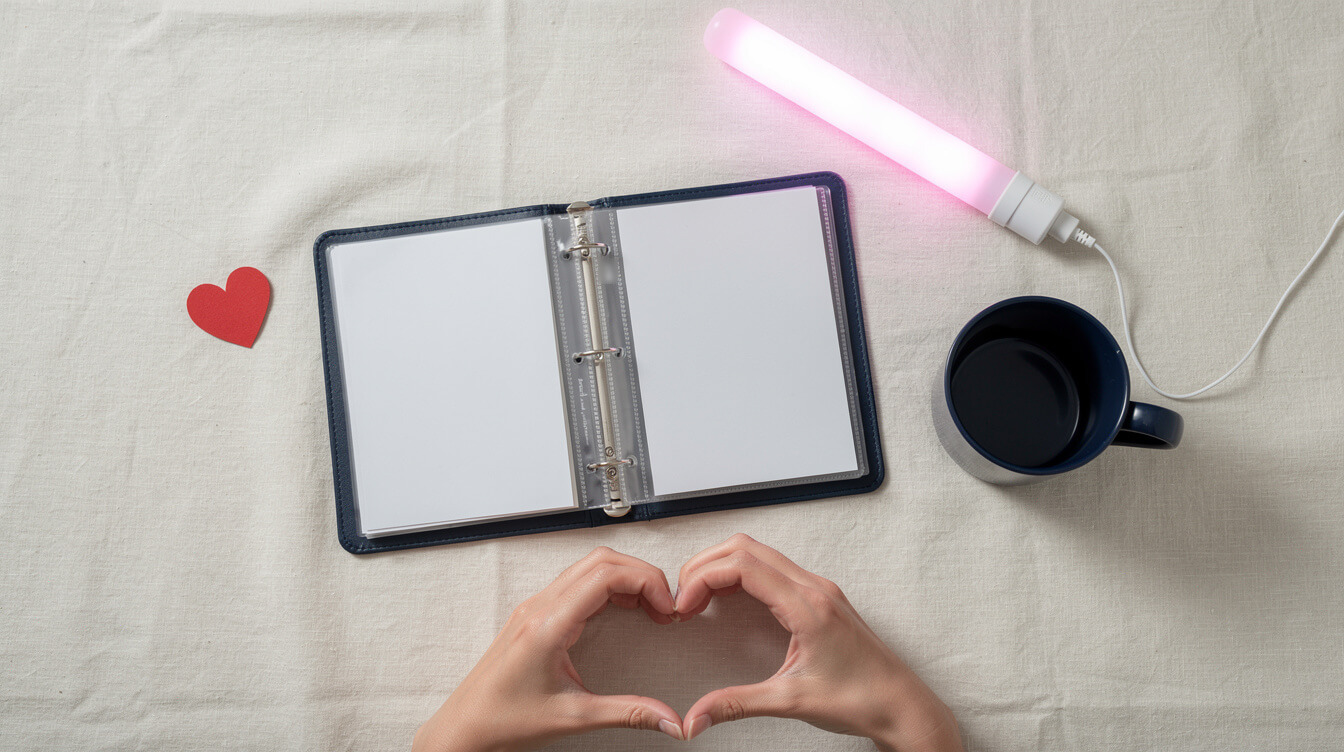
Concerts are a two-way heart exchange. Idols send finger hearts and arm hearts to the crowd during ments (the talking breaks between songs), during the encore, and at the end of the show. The polite, and fun, response is to send one back. With a lightstick in one hand, the finger heart is your one-hand reply. Hold it up toward the stage, in the light, for a second or two.
If you’re making your concert plan, add “practice hearts” to it. Laugh, but you’ll want your finger heart to be automatic when the moment comes, and not something you’re figuring out with shaking hands.
At hi-touch and fansign events
A hi-touch is a quick line where fans walk past the members and high-five them, often in a few seconds per person. A fansign is a sit-down event where you get a moment with each member while they sign your album. At both, the finger heart is the universal short message. You don’t need Korean, you don’t need a speech, and it fits the time you actually have. Many fans plan a small exchange: a finger heart, a smile, and a quick 화이팅 or 사랑해요 (saranghaeyo, the polite “I love you”).
One etiquette note: if an idol makes a heart for you, enjoy it. Don’t demand a specific gesture, and don’t hold up the line asking for a retake. Staff are managing time for everyone behind you.
On photocards
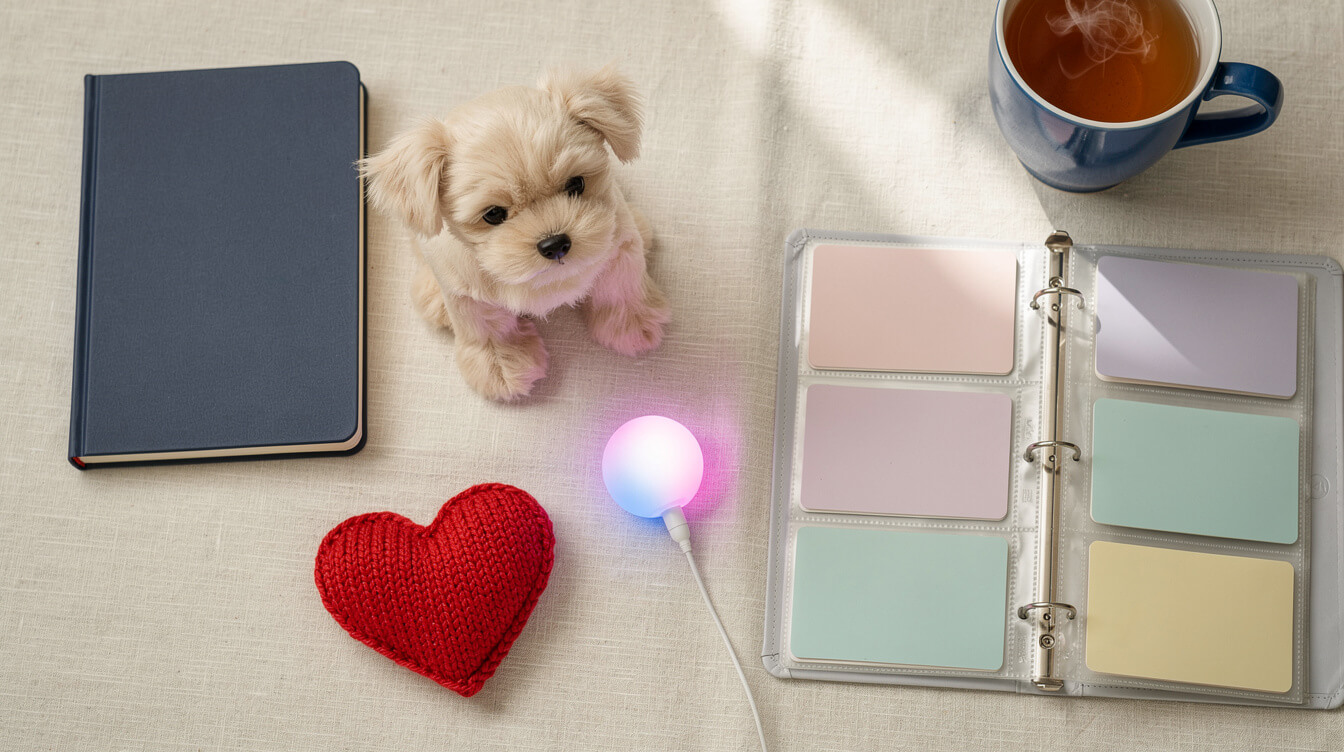
Open any photocard binder and you’ll find finger hearts. It’s a classic photocard pose, right up there with the V sign and the cheek heart. If you’re new to collecting and the vocabulary around it, our guide to what a bias is in K-pop explains why everyone is chasing one specific person’s card. When your bias wrecker pulls a finger heart pose on a rare card, well, you have our sympathy.
In selcas and friend photos
Selca (셀카, selka) is Konglish for “selfie”, from “self camera”. The finger heart is the default selca pose for a reason: one hand holds the phone and the other makes the heart. Fans copy idol selca poses all the time, and the finger heart is the easiest one to get right. In group photos with your concert buddies, try one each, or have everyone make a two-hand heart at once.
In fan letters and messages
You can’t send a gesture in a letter, but you can draw one. Fans often sketch a little finger heart next to a sign-off like 사랑해요 or on a birthday message. If you’re writing one, our happy birthday in Hangul guide walks you through writing 생일 축하해 by hand.
When the finger heart can be misread
The finger heart is about as safe as gestures get, but its shape sits close to a couple of others, so it’s worth knowing the overlaps.
The money gesture. In many countries, rubbing your thumb against your index and middle fingers means “money” or “expensive”. A finger heart is still, with the fingers crossed, but a quick or fidgety one can look like that rub, especially to someone who has never seen a K-pop stage. That’s also why 🫰 sometimes means money in texts. The fix is easy: hold the heart still for a beat, and keep your other fingers curled.
The OK sign. As covered in the mistakes section, a finger heart with the fingertips touching in a ring becomes an “OK” sign, and the OK sign doesn’t mean the same thing everywhere. Cross your fingers properly and you avoid the issue.
The snap. Sometimes a finger heart is just someone getting ready to snap. Context, again.
None of this is cause for worry. Outside fandom spaces, most people now recognize the Korean finger heart, and anyone who doesn’t will usually ask, which is your chance to explain it. Fan to new fan, that’s how this whole thing spreads.
Korean finger heart FAQ
What is the Korean finger heart called in Korean?
손가락 하트 (songarak hateu, “finger heart”), or 손하트 (sonhateu, “hand heart”). Both are common.
Is the finger heart romantic?
Not by default. It’s affectionate and friendly. Idols send it to fans, friends send it to friends, and kids send it to their grandparents. Context decides, as with any heart.
Which hand should I use?
Either. Most people use their dominant hand, but at a concert, use whichever hand isn’t holding the lightstick.
When did the finger heart emoji come out?
🫰 “Hand with Index Finger and Thumb Crossed” and 🫶 “Heart Hands” were both part of Emoji 14.0, released in 2021.
Who invented the finger heart?
Nobody knows for sure. It spread through Korean entertainment in the 2010s, with several celebrities credited at different times. We’d rather leave it as a happy fandom debate than pick a winner.
Why does my finger heart look like an OK sign?
Your fingertips are meeting in a circle instead of crossing. Slide your thumb over the side of your index finger, near the tip, and bend the index finger a bit more.
What should I do if an idol sends me a finger heart?
Send one back, and try not to scream. Or scream. We’ve all been there.
From the shop
Busan Korea Hillside Village Scenic T-Shirt
Price range: $24.99 through $26.99
Shop this designMake it, send it, mean it
The Korean finger heart is tiny, but it carries a whole fandom’s worth of meaning. It’s how idols say thank you without words, how fans answer from the dark of an arena, and how your group chat says “I love this” in one character. Learn to cross your fingers properly, raise it where the light can catch it, and send it back every time one comes your way.
And if you want the words to go with it, start with 사랑해 and 화이팅. Between the two words and the one gesture, you can say almost everything a fan needs to say. 화이팅!
Before you log off
Get the next one in your inbox
We write about Korean phrases, fandom culture and concert life every day. The best of it lands in one short weekly email.