Photocard size: how big a K-pop photocard is, what fits it, and how fans trade
You pull a card from a new album, it’s your bias, and your first thought is: where do I put this so it never, ever bends? Then you go to buy sleeves and every listing gives you a different number. So here’s the answer, fan to fan. The standard K-pop photocard size is 55 x 85 mm, about 2.17 x 3.35 inches. That’s almost exactly the size of the bank card in your wallet.
That number is the start. Below I cover why some sites tell you 2.5 x 3.5 inches (they’re describing a different card), which sleeves and binder pages actually fit, the Korean words you’ll see on every trade post, and how trading works without anyone getting hurt, scammed, or left with a dented corner.
What size is a K-pop photocard? The short answer
A standard album photocard measures 55 x 85 mm (5.5 x 8.5 cm). In inches that’s about 2.17 x 3.35 in. Hold it portrait and it’s 55 mm wide and 85 mm tall.
You don’t have to take a fan blog’s word for it. Korean album listings usually include a spec sheet called 앨범 사양 (aelbeom sayang, “album specifications”), and it lists every component with its size. A typical line reads 포토카드 : 55*85mm / 14종 중 랜덤 2종: photocard, 55 by 85 mm, 2 random cards out of 14 types. Read enough of those spec sheets and 55*85mm shows up again and again, from big releases to small ones.
The credit card comparison
Fans call photocards “credit card sized,” and the comparison holds up. Bank cards follow an international standard, ISO/IEC 7810 ID-1, which sets them at 85.60 x 53.98 mm. A photocard is within about a millimeter of that in both directions. If you’re ever unsure whether a holder or wallet slot will fit your card, test it with a bank card first. It’s the closest stand-in most of us carry.
What the word means in Korean
In Korean it’s 포토카드 (poto kadeu), the English word “photo card” written in Hangul. Almost nobody says all four syllables. Fans shorten it to 포카 (poka), and you’ll see that clipped form on trade posts, in fan cafes, and stuck onto other words like 포카 바인더 (photocard binder). If someone asks “포카 뭐 나왔어?” they’re asking which photocard you pulled.
Why some sites say photocards are 2.5 x 3.5 inches
Search “photocard size” and you’ll find some confident answers saying 2.5 x 3.5 inches. That’s a real standard, just not ours. It’s the trading card size. Topps moved its baseball cards to 2-1/2 x 3-1/2 inches in 1957, and that became the basic format for most US sports cards and the collectible card games that came later.
In metric, a trading card is about 63.5 x 88.9 mm. Put a photocard next to one and the difference is easy to see:
- Width: a photocard is about 8.5 mm narrower (55 vs 63.5 mm).
- Height: a photocard is about 4 mm shorter (85 vs 88.9 mm).
Those few millimeters matter more than they sound. A photocard in a trading-card sleeve slides around, and a loose card in a toploader shifts in the mail, which is how corners get dinged. Trading-card binder pockets are also built for the wider card, so photocards can sit crooked or slip down. The fix is simple: buy supplies made for photocards, not supplies made for baseball cards.
“My card measures a little different”
That happens. 55 x 85 mm is the standard, not a law. Special editions, merch cards, and event cards can come in other sizes and shapes, and some “mini” cards are actually larger than a regular photocard. If a card looks different, measure it with a ruler before you order anything. Two minutes with a ruler saves you a pack of sleeves that don’t fit.
Photocard types and what fans call them
Not every photocard comes out of an album, and the type changes how rare it is, how people trade it, and sometimes its size. These are the categories you’ll see, with the Korean shorthand fans use.
Album photocards: 앨포
The card that comes packed randomly inside an album is the 앨범 포카, shortened to 앨포 (aelpo, “album photocard”). This is the most common type and the one almost everyone starts with. The randomness is the whole game: you don’t know which member you’ll get until you open it, which is how trading began in the first place. The spec-sheet line I quoted above (“2 random cards out of 14”) is an album pull.
Pre-order benefits: 미공포 and 특전
A 특전 (teukjeon) is a special bonus, the “benefit” in “pre-order benefit.” When a store gives an exclusive photocard with a pre-order, fans usually call it a 미공포 (migongpo), short for 미공개 포토카드 (migonggae poto kadeu, “unreleased photocard”). Each participating store gets its own design, and you can only get it from that store during a limited window. That’s why 미공포 cards are harder to find later, and why fans keep spreadsheets of which store gets which set.
Event and broadcast cards
Some cards only go to fans who show up in person. Cards handed out at fansign events, lucky draws, and music show recordings fall here. Fans call the broadcast ones 공방포카 (gongbang poka), from 공개방송 (gonggae bangsong), a show filmed with a live audience. If you’ve read my guide to comeback season, these are the cards that come out of those early-morning pre-recording lines. Fewer people can attend, so fewer cards exist.
Fan-made cards and reprints
Fans make cards too. Birthday cafes and fan events often give out free fan-made photocards as part of the event goodies, and they’re lovely keepsakes. They aren’t official, and nobody pretends they are. A 스캔포카 (seukaen poka, “scanned photocard”) is different: it’s a printed copy of an official card’s image. If you want to know whether you’re getting an official card, ask, and compare it with a known official card from the same set.
Sleeves, toploaders, and binders that fit your photocard size

Once you know the size, choosing supplies gets easy. Most fans protect cards in layers: a soft sleeve, then a rigid toploader if the card is traveling, then a binder for everything else.
Sleeves
A sleeve is the thin clear plastic pocket that goes directly around the card. The rule of thumb is 1 to 2 mm of room on each side: snug enough that the card doesn’t slide around, loose enough that you can slip it in without catching a corner. For a 55 x 85 mm card, sleeves are commonly sold around 57 x 88 mm for a snug single sleeve and around 61 x 91 mm as an outer sleeve. Exact sizes vary by maker, so check the listing against your ruler.
Double sleeving means putting a sleeved card inside a second, slightly larger sleeve. People do it for a card they’d cry over, or one that’s about to go in the mail.
Toploaders
A toploader is a rigid clear plastic case, open at the top. In Korean trade posts you’ll see it written 탑로더, the English word in Hangul. It’s what stops a card from bending in a bag or envelope. A sleeved card should go in without forcing. Leave the toploader bare of tape and stickers on the card side, because tape that touches the card can pull off its finish.
Binders
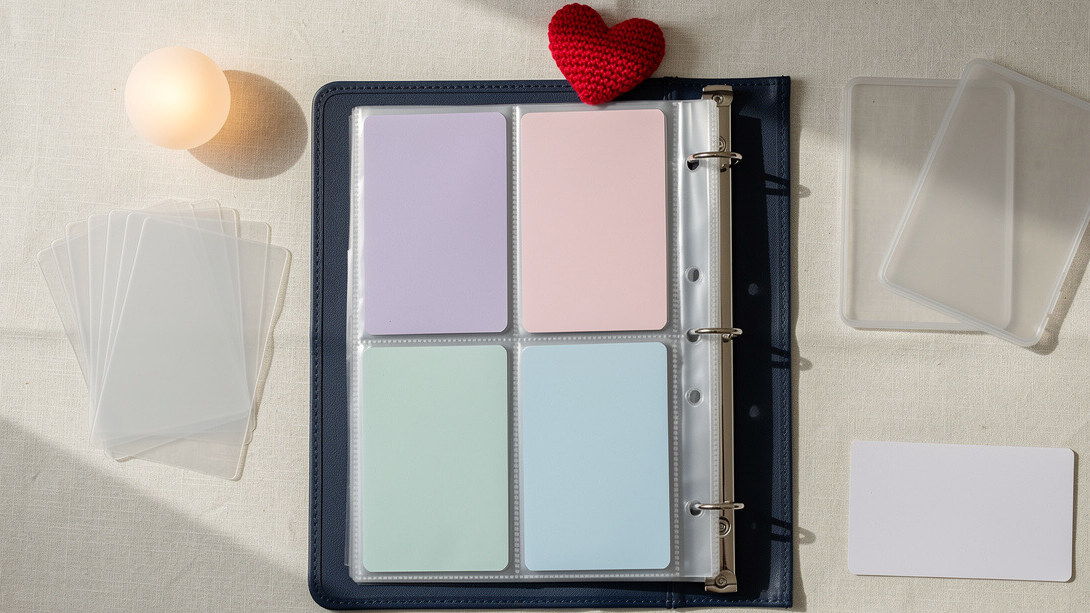
Photocard binders (포카 바인더 or 포카북 in Korean posts) use pocket pages sized for photocards, usually two, four, or nine pockets per page side. Check that the pockets fit your sleeve size, not your bare card, if you store cards sleeved. Then put the binder somewhere cool and out of direct sun, because printed cards fade and paper hates humidity.
Taking cards to a concert or a meetup to trade? My concert-day checklist covers how to pack sleeves and toploaders so nothing gets crushed in the line.
Fan mail
One email a week, written like a group chat
The Korean word everyone's using, the fandom ritual behind it, and the newest designs before they hit the shop. No spam. Unsubscribe anytime.
Photocard trading terms in Korean and English
Trade posts are written in shorthand, and the shorthand changes depending on whether the poster is writing in English or Korean. Here’s the glossary I wish I’d had for my first trade.
The English acronyms
- WTT: want to trade.
- WTS: want to sell.
- WTB: want to buy.
- ISO or LF: in search of / looking for.
- FT: for trade.
- NFS: not for sale. That’s someone’s keeper. Don’t ask twice.
- EQ: equivalent, usually meaning a card from the same album or version.
- Have / Want: the two lists at the heart of every trade post.
The Korean words
| Hangul | Romanization | What it means on a trade post |
|---|---|---|
| 포카 | poka | Photocard (short for 포토카드) |
| 앨포 | aelpo | Album photocard, a random album pull |
| 미공포 | migongpo | “Unreleased” photocard, usually a store pre-order benefit |
| 특전 | teukjeon | A bonus or benefit (pre-order, event) |
| 교환 | gyohwan | Exchange: a card-for-card trade, no money |
| 양도 | yangdo | Handing over for money, a sale |
| 동시발송 | dongsi balsong | Both sides ship at the same time and share tracking |
| 택포 | taekpo | Price includes shipping (택배비 포함) |
| 하자 | haja | A flaw: scratch, dent, print mark |
The difference between 교환 and 양도 is the one to remember. 교환 (gyohwan) is a swap, and 양도 (yangdo) literally means “transfer,” but on a photocard post it means the card is going for money. If you only want trades, say so in your post.
How photocard trading works, step by step
Every fandom does this a little differently, but a safe trade almost always follows the same shape.
- Post or answer a have/want list. Include the album, version, and type (album pull, pre-order benefit, event card), and be upfront about any 하자.
- Ask for proof. The standard is a photo or short video of the card next to a piece of paper with the other person’s username and today’s date. Flash shows up scratches and print quality. Ask for the front and the back.
- Agree on everything before anyone ships. Which cards, the shipping method, tracked or not, the ship date, and how you’ll pack. Write it in the chat so you both have it.
- Decide who ships first, or ship together. For trades, 동시발송 is the norm: both people ship on the same day and share tracking numbers. Some communities ask the person with less trade history to go first. There’s no single rule, so just agree before anything moves.
- Pack it like it’s yours. Sleeve, toploader, and a piece of cardboard on each side so the card can’t bend. Add a waterproof layer for long trips. No tape on the card or inside the toploader.
- Confirm arrival. Message when it lands, check the condition right away, and leave feedback if your community uses it.
Red flags
Walk away if someone refuses proof photos, pushes you to send right now, avoids tracking on a valuable trade, or sends proof that looks reused. Never click a payment link someone sends you. Use the platform’s own checkout. Another copy of the card will turn up.
Many photocard traders are teenagers. If that’s you, trade with a parent or guardian in the loop, especially when money is involved. It’s not about being treated like a kid. It’s about having someone on your side if something goes wrong.
Photocard trading etiquette: the unwritten rules
Photocards exist because albums are random, and fans have always had mixed feelings about that. Kukinews reported in 2024 on a Korea Consumer Agency survey: among 389 people who had bought K-pop albums, 52.7% said they bought them to collect goods like photocards. The same report noted an album with as many as 78 card types. That’s why trading matters. It’s how fans finish a set without buying a stack of albums they don’t need.
Some rules come from that shared reality:
- Don’t flip free things. Fan-made cards from a birthday cafe or a free giveaway were given in good faith. Reselling them at a markup is widely seen as bad manners.
- Describe flaws honestly. A tiny scratch you mention is fine. One you hide ends your reputation.
- Don’t ghost. If plans change, say so quickly. A no-show is the fastest way to get left out of trading circles.
- Never shame anyone’s collection. Someone’s “duplicate” is someone else’s ult. Someone’s bias is not a worse card. We don’t do member-ranking in trade posts, or anywhere.
- Collect for joy, not as an investment. Prices go up and down. The card you love is worth what it means to you.
Still figuring out whose cards you’re chasing? Start with what a bias is. And if your binder keeps filling up with cards from the “wrong” member, you may have a bias wrecker on your hands.
Photocard size FAQ
What is the standard K-pop photocard size in inches?
About 2.17 x 3.35 inches, which is 55 x 85 mm.
Is a photocard the same size as a Pokémon or baseball card?
No. Those are trading cards, 2.5 x 3.5 inches (about 63.5 x 88.9 mm). A photocard is roughly 8.5 mm narrower and 4 mm shorter, so trading-card sleeves fit loosely.
Is a photocard the same size as a credit card?
Almost. A bank card is 85.60 x 53.98 mm under ISO/IEC 7810 ID-1, within about a millimeter of a photocard.
What size sleeve do I need?
Aim for 1 to 2 mm of room on each side. Sleeves around 57 x 88 mm are a common snug fit, and around 61 x 91 mm is common for an outer sleeve. Measure your card and check the listing.
What does 포카 mean?
포카 (poka) is the short form of 포토카드 (poto kadeu), “photocard.”
What is a 미공포?
미공포 (migongpo) is short for 미공개 포토카드, “unreleased photocard.” It’s usually a store-exclusive pre-order benefit that isn’t in the album itself.
Why are some of my cards a different size?
Special editions, merch cards, and event cards don’t always follow the standard. Measure each odd one before you buy supplies for it.
From the shop
Busan Korea Hillside Village Scenic T-Shirt
Price range: $24.99 through $26.99
Shop this designFinal thoughts
Here’s what to remember: 55 x 85 mm, about the size of your bank card, and a little smaller than a baseball card. Get sleeves with a millimeter or two of room, put a toploader around anything that leaves the house, and keep your binder out of the sun.
The rest of the hobby is people. Ask for proof, ship together, describe flaws honestly, and never sell free fan gifts for a profit. Most traders you meet will be just as nervous about their first trade as you were, and plenty of fan friendships started with one swap. If you’re collecting toward a birthday cafe or a fan event, my guide to writing happy birthday in Hangul will help you sign the card.
May your next pull be your bias. 화이팅!
Before you log off
Get the next one in your inbox
We write about Korean phrases, fandom culture and concert life every day. The best of it lands in one short weekly email.